2026 Global Open-source AI Challenge (GOAI)「Embodied Future」Track Open for Registration
Enable AI to Complete Authentic Tasks in the Physical World
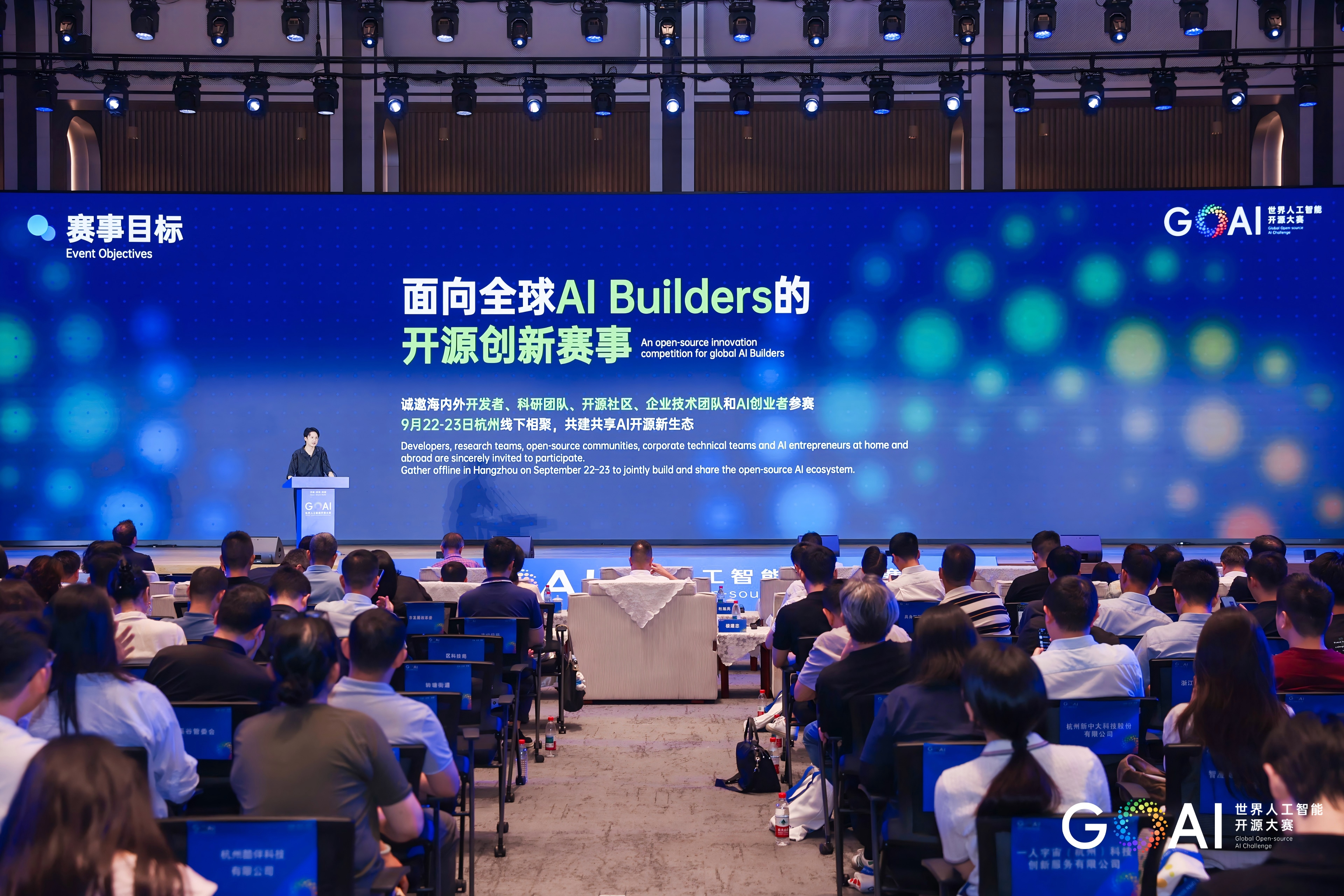
On July 21, 2026, the first Global Open-source AI Challenge (GOAI) officially kicked off at the Hangzhou Cloud Valley Center. As one of the core competition tracks, the Embodied Future Track centers on open-source embodied intelligence and physical world interaction. It sets two major challenges: "General Dual-arm Collaborative Manipulation Evaluation" and "Industrial Park All-terrain Patrol Challenge". Participating teams are encouraged to build operable, reproducible and evaluable embodied intelligence solutions.
At the launch ceremony, guests from academia, industry and open-source communities reached a consensus: artificial intelligence is expanding from the digital realm to the physical world. The ability of models to comprehend language and recognize images is merely a starting point. Whether AI can perceive environments, plan motions, control machinery and accomplish real-world tasks will determine if embodied intelligence can be widely adopted in production and daily life. The launch of the Embodied Future Track addresses this cutting-edge industry frontier.
Track Background: Why the Embodied Future Track Matters
Nowadays, technologies including vision-language-action models, world models, reinforcement learning, multi-modal perception and robot control are advancing rapidly, shifting embodied intelligence from isolated capability demonstrations to real-task validation. Nevertheless, multiple practical hurdles remain in the transition from "motion-capable models" to "robots that reliably complete end-to-end tasks".
A dual-arm robot must not only identify objects, interpret instructions and plan movements, but also coordinate two manipulators, tackle visual occlusion, grasping deviation, shifting object positions and task state transitions. Robots deployed for park patrols need to navigate slopes, gravel roads, narrow staircases, slippery surfaces, dynamic obstacles and unknown terrain, while completing localization, navigation, obstacle avoidance and task scheduling within limited time windows.
All these challenges lead to a clear conclusion: advancing embodied intelligence from "being able to move" to "being able to deliver finished work" demands deep integration of perception, planning, control, simulation, hardware and validation systems. The core metric is not what fancy motions a robot can demonstrate, but whether it can fully execute tasks, deliver valid results and properly handle unexpected incidents in physical environments.
This forms the core logic behind the Embodied Future Track: to push AI beyond screen interfaces into the physical world, demonstrating its capabilities and creating tangible value through real-world task execution.
Track Positioning: Open-source Embodied Intelligence and Physical World Interaction
The Embodied Future Track targets practical challenges in robot-physical environment interaction, focusing on open embodied intelligence systems with full perception, decision-making and execution capabilities. Participants are invited to develop operable, reproducible and evaluable solutions for two designated challenge scenarios: complex dual-arm robotic manipulation and all-terrain patrols in real industrial parks, alongside corresponding demos, codes, technical documentation and open-source roadmaps.
This track evaluates complete closed-loop systems rather than isolated demos, enabling AI to migrate from digital spaces to physical environments and empowering robots to generate verifiable decisions and actions during real tasks.
The track discourages one-off fixed-motion demos that only work under ideal conditions, as well as submissions limited to model metrics, simulation screenshots or conceptual frameworks. Instead of showcasing "new robot motions", the Embodied Future Track seeks robust, practical solutions that allow embodied intelligence to reliably carry out tasks in real physical environments.
Core Requirements: Prioritize Real-World Executability Over Model Itself
The Embodied Future Track does not focus on comparing model sizes or isolated single indicators; its core evaluation metric is whether robots can complete tasks in real or near-real environments. Competitive embodied intelligence solutions shall translate model performance into stable execution capabilities, forming closed loops covering model functionality, system engineering and real-task validation. Judges assess not only model performance but also the integrity of the full engineering pipeline, and the closed loop encompassing perception, planning, control, simulation, deployment, runtime logs and result verification.
Judges expect an end-to-end workflow covering task input and environmental perception, decision planning, motion execution, state feedback, result validation, exception handling, safe degradation and runtime evidence archiving. GOAI aims to recruit teams proficient in deploying robots for "steady real-world operations": accurately perceiving surroundings, optimizing motion plans, fully completing assigned tasks and mitigating potential risks.
Eligible Participants: Teams Covering the Full Embodied Intelligence Pipeline
The Embodied Future Track is open to global universities, research institutes, corporate technical teams, robotics developers and open-source community members. Eligible participants include algorithm teams researching Vision-Language-Action (VLA), world models and reinforcement learning, as well as engineering teams specializing in robot control, autonomous navigation and sensor fusion. Qualified entrants range from university labs with cutting-edge research outputs to enterprise teams with hands-on industrial site experience.
Participants may register as individuals or teams of up to 3 members. Detailed team formation rules are subject to the official competition website and participant handbook. Anybody working in algorithm research, robot control, simulation training, motion planning, autonomous navigation or system integration is welcome, provided they focus on enabling robots to complete real-world tasks.
The track especially values teams capable of seamlessly integrating algorithms, systems and hardware. Participants are not required to build the largest-scale models, but must clearly define task objectives and validation standards. They do not need to adopt the most complex tech stacks, yet must deliver stably operating systems and explain performance gaps between simulation and physical deployment.
Submission Requirements: Operable, Reproducible and Evaluable
All entries shall build embodied intelligence solutions tailored to the assigned challenges, with clear documentation covering target tasks, system architecture, technical roadmaps, input/output specifications, success criteria, data sources, third-party dependencies, safety boundaries and open-source plans.
Submissions must form fully operable, reproducible and evaluable solutions. Teams shall demonstrate the core workflow from task input to result delivery via functional real-world demos, simulation outputs, or task footage, and provide source code, environment configuration guides, deployment tutorials and operation instructions to facilitate judge review. All projects shall define clear task metrics, success benchmarks and evaluation methodologies, substantiating practical performance via platform scores, experimental data, runtime logs or on-site demonstration results. Teams must fully disclose the origins of all models, datasets, tools and external services, retaining complete records and anomaly logs to ensure traceable processes and verifiable outcomes. The system shall incorporate emergency stop, rollback, safe degradation and manual takeover mechanisms to address perception failures, motion deviations, path abnormalities and hardware malfunctions, guaranteeing stable and secure robot operation during real tasks.
Two distinct challenge tracks are available for teams to select based on their capabilities and resource access:
Track 1: General Dual-Arm Collaborative Manipulation Evaluation
This challenge invites teams to design and optimize cutting-edge end-to-end embodied manipulation models such as Vision-Language-Action (VLA) and World Action Model (WAM) based on the integrated X-Eval simulation and physical robot evaluation platform, conducting algorithm development and performance benchmarking for complex dual-arm robotic manipulation scenarios.
Track 2: Industrial Park All-Terrain Patrol Challenge
Built upon the real Cloud Valley industrial park environment, this challenge features complex terrain including slopes, gravel, narrow staircases and slippery surfaces, alongside unknown obstacles and dynamic interferences. Robots are required to complete multi-waypoint inspection, path planning and task scheduling within restricted time limits.
Notably, the track permits the use of commercial APIs, closed-source models and third-party tools, provided all usage complies with relevant laws and regulations. Teams must fully disclose the purpose, source, permission scope, invocation limits and external dependencies of all third-party resources. For the dual-arm manipulation challenge, closed-source models shall not constitute the core solution; core methodologies must demonstrate open collaborative value.
Evaluation Criteria: "Real Tasks, Live Execution and Authentic Validation"
Differentiated evaluation priorities are applied to the two challenges of the Embodied Future Track based on their respective characteristics. The Dual-Arm Collaborative Manipulation Challenge emphasizes model design, simulation performance, physical robot transfer potential, dual-arm coordination, manipulation stability, execution efficiency, robustness and generalization ability.
The All-Terrain Patrol Challenge prioritizes path planning, autonomous navigation, scene comprehension, real-time localization, complex terrain traversal, dynamic obstacle avoidance, real-time decision-making and overall task completion rate.
Beyond specialized technical capabilities, judges will also assess demo stability, verifiable end-to-end task workflows, clear deployment and reproduction pipelines, credible evaluation results, comprehensive exception handling and safety mechanisms, as well as full disclosure of models, datasets, hardware interfaces and third-party dependencies.
Evaluation prioritizes full task completion before assessing the technical architecture enabling such results, and stable robotic operation before evaluating advanced model and algorithm performance. A heavily edited single successful demo carries far less weight than a complete repeatable system that can explain failures and safely resolve unexpected anomalies.
Schedule & Awards: From Simulation Validation to On-Site Physical Robot Demonstrations
Registration for the Embodied Future Track opened on July 16, with the preliminary submission deadline set for August 20. Expert preliminary reviews will take place August 21--23. Shortlisted teams will conduct physical robot debugging and final preparation August 25 -- September 20. The offline grand finals, defenses and demonstrations will be held September 22--23, with the award ceremony scheduled on September 23. All schedules are subject to final official notices issued by the organizing committee.
Phased evaluations drive entries from conceptual technical blueprints to real-task validation. Preliminary round reviews focus on project positioning, technical feasibility, validation frameworks and open-source value. The dual-arm manipulation challenge prioritizes model design and simulation performance, while the patrol challenge highlights perception-control fusion, autonomous navigation and scene comprehension. Subsequent evaluation stages shift the focus to demo operability, engineering completeness, benchmark results and standardized open-source implementation. Grand final judging assesses not only stable task execution in real or near-real environments, but also teams' ability to articulate the synergy between models, system engineering and hardware, alongside the project's industrial deployment potential, sustained open-source value and long-term growth prospects.
In terms of awards, each challenge grants one Champion, one First Runner-Up and one Second Runner-Up, with cash prizes of RMB 250,000.00, RMB 150,000.00 and RMB 50,000.00 respectively. Additional special awards include the Algorithmic Innovation Award, Rising Star Team Award and Outstanding Open-source Project Award. Top-performing projects will also qualify to compete for the GOAI Grand Prize of RMB 1,000,000.00.
Closing Remarks: Empower Robots to Shift from "Basic Motion" to "Reliable Operation"
The core difficulty of embodied intelligence lies in the absence of fixed standard solutions within the real world. While simulation enables rapid training, debugging and comparative testing of solutions, the ultimate value of embodied intelligence must be validated through real or near-real tasks. The Embodied Future Track seeks teams capable of unifying algorithmic performance, system engineering and real-task validation. It aims to move AI beyond impressive digital demonstrations to become a reliable, trustworthy and deliverable operational force in the physical world.
Registration is now open. Visit the official website goaihz.com to sign up, download the track participant handbook and view full challenge details.
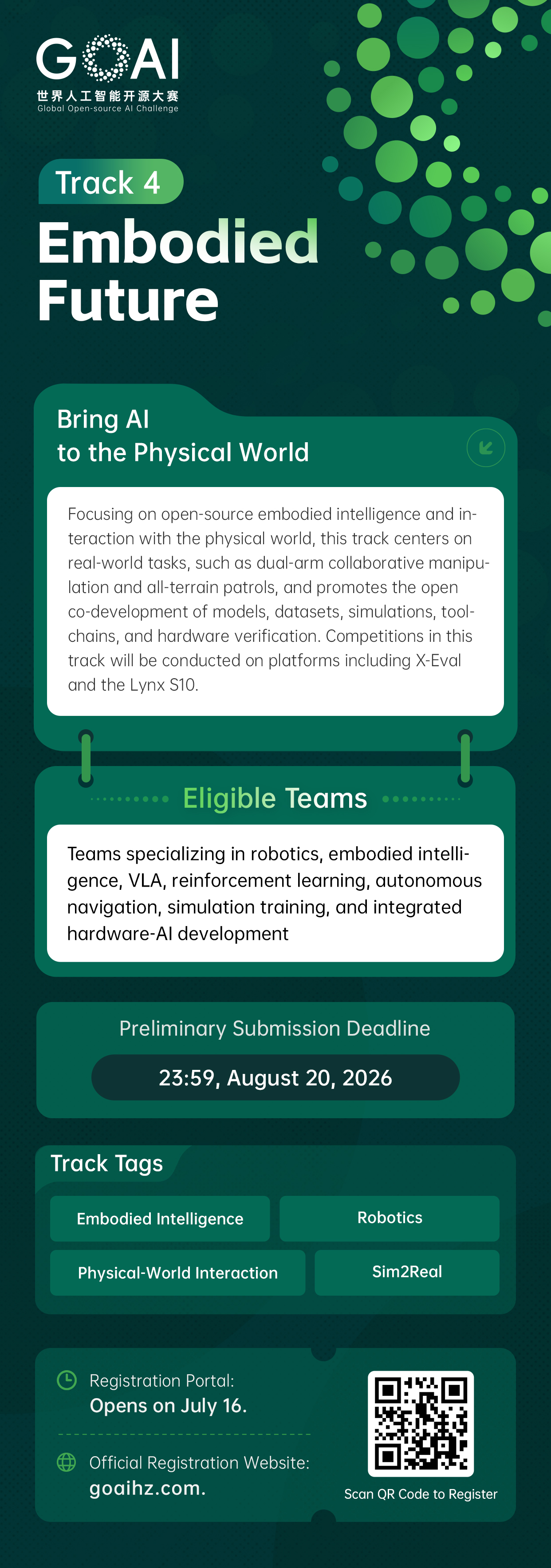 Long press to scan the QR code and register immediately
A total prize pool of 5 million RMB awaits challengers (Competition Registration QR Code)

Scan the QR Code to add GOAI Assistant
Your exclusive competition guide is online (GOAI Assistant QR Code)